
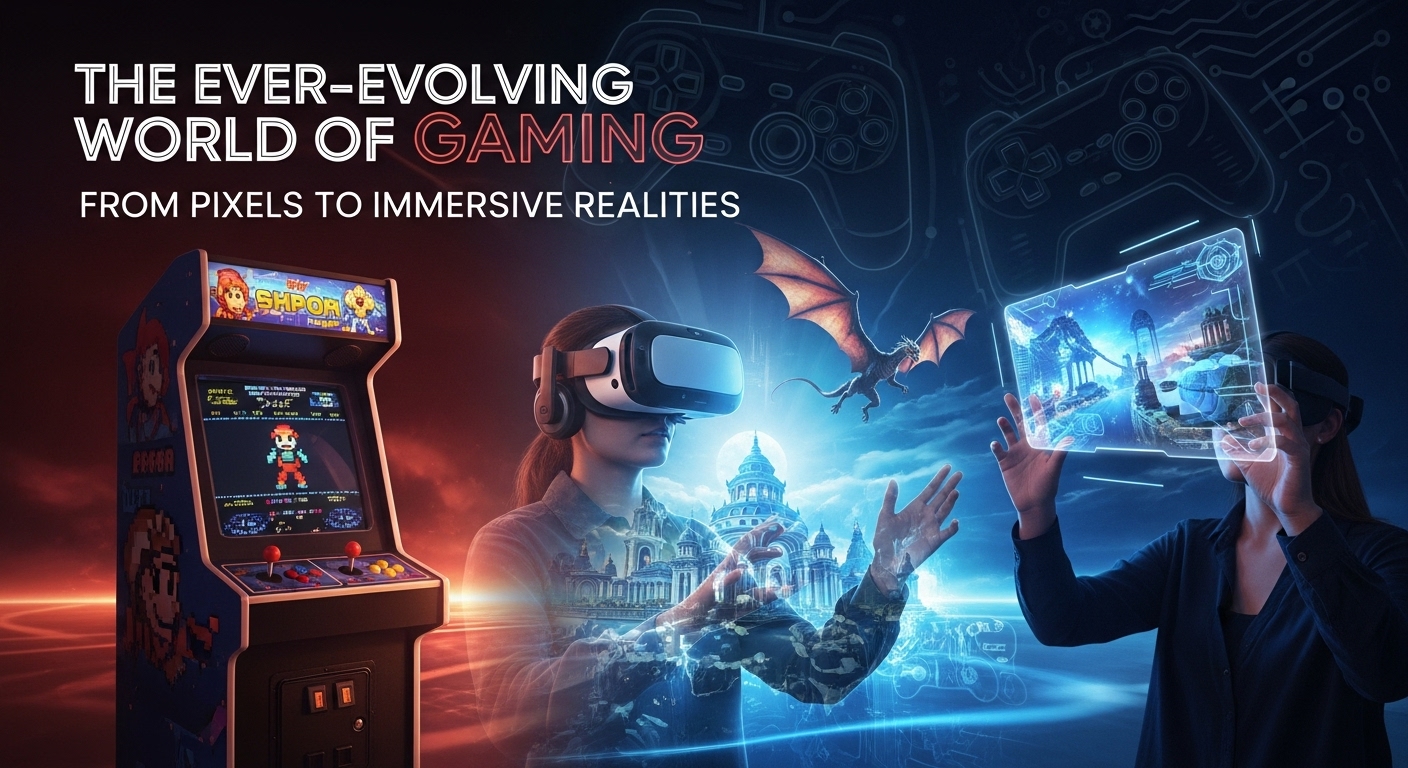
Introduction: The Rise of an Industry
Gaming has become one of the most dominant cultural forces of the 21st century. What began as a simple pastime involving blinking lights and pixelated characters has evolved into a multi-billion-dollar industry that influences entertainment, technology, education, and even the way we interact with one another. It is no longer just a hobby for a select group of enthusiasts; gaming has become a global language that transcends age, gender, and nationality.
From the humble beginnings of arcade machines to the breathtaking realism of modern virtual worlds, gaming’s journey reflects the progress of human creativity and innovation. The story of gaming is not only about technology but also about imagination, storytelling, and community.
The Early Days: When Pixels Ruled the World
In the late 1970s and early 1980s, gaming was a curiosity, a new form of entertainment that seemed magical. Arcade cabinets like Space Invaders, Pac-Man, and Donkey Kong introduced the concept of interactive entertainment. For the first time, players weren’t just watching a story unfold — they were part of it.
Home consoles soon followed, bringing that excitement into living rooms. The Atari 2600, Nintendo Entertainment System, and Sega Genesis became household names. These machines were primitive by modern standards, but they introduced a sense of wonder that laid the foundation for everything that came after.
The early games were simple — move a paddle to hit a ball, jump over obstacles, shoot the enemy. But even in their simplicity, they offered something profound: challenge, creativity, and a sense of control that no other medium could provide.
The 1990s: The Birth of Modern Gaming
The 1990s were a golden age. Technology advanced rapidly, and so did the ambitions of game developers. The introduction of 16-bit consoles like the Super Nintendo and Sega Mega Drive brought vibrant colors, detailed sprites, and richer soundtracks. For many, this was the first time games began to tell deeper stories.
Titles like The Legend of Zelda: A Link to the Past, Final Fantasy VI, and Chrono Trigger proved that games could deliver emotional depth and narrative complexity. Meanwhile, the arrival of 3D graphics in the mid-90s changed everything. Games like Super Mario 64 and Tomb Raider opened the door to fully realized 3D worlds, allowing players to explore and interact in ways that were previously unimaginable.
This was also the era when PC gaming began to thrive. With the rise of CD-ROMs, games like Myst and Doom captivated audiences with their immersive worlds and revolutionary graphics. Online multiplayer gaming also made its debut, setting the stage for the massive online worlds that would come later.
The 2000s: The Age of Connectivity
The turn of the millennium brought a new phase — the age of online gaming. High-speed internet connections and more powerful consoles made it possible for players to connect, compete, and cooperate with others across the globe.
Massively multiplayer online role-playing games (MMORPGs) like World of Warcraft became cultural phenomena, creating entire virtual societies with their own economies and hierarchies. Shooters like Halo 2 and Call of Duty redefined online competition, introducing ranking systems, clans, and voice chat that fostered teamwork and rivalry alike.
The 2000s also saw the rise of gaming as a legitimate storytelling medium. Games like Metal Gear Solid 2, Shadow of the Colossus, and BioShock explored philosophical and emotional themes, blurring the line between art and entertainment.
At the same time, gaming began to reach a wider audience. The introduction of the Nintendo Wii in 2006 brought motion controls into homes and appealed to casual players, families, and even seniors. Gaming was no longer a niche — it was mainstream.
The Modern Era: Immersion, Innovation, and Inclusivity
Today, gaming has reached a level of sophistication that early developers could only dream of. Ultra-realistic graphics, powerful processors, and cloud computing have made possible experiences that feel cinematic, emotional, and deeply interactive.
The rise of open-world games like The Witcher 3: Wild Hunt, Red Dead Redemption 2, and Elden Ring has allowed players to live entire lives in virtual worlds. These games combine rich narratives, dynamic environments, and player freedom in ways that make each journey unique.
Indie games have also flourished, proving that innovation doesn’t always require massive budgets. Titles like Undertale, Hollow Knight, and Celeste have won hearts through creativity, storytelling, and emotional depth. The indie scene has redefined what gaming can be, showing that passion and vision can rival technology.
Virtual reality (VR) and augmented reality (AR) are pushing immersion even further. With VR headsets, players can step inside the worlds they once viewed through screens. Games like Half-Life: Alyx and Beat Saber demonstrate the power of presence — that magical feeling of being there.
The Social Power of Gaming
Gaming is not just about pixels and controllers; it is about connection. Millions of players form friendships, communities, and even careers through games. Streaming platforms and esports have transformed gaming into a spectator sport, with professional players achieving celebrity status.
Esports tournaments fill stadiums, and millions watch from home as teams compete in titles like League of Legends, Valorant, and Counter-Strike. The skill, strategy, and teamwork displayed rival those of traditional sports, while the fan culture surrounding them is just as passionate.
Social gaming has also become a way for people to stay connected. During challenging times, such as global lockdowns, online games provided an escape and a social lifeline. Games like Animal Crossing: New Horizons became virtual meeting spaces where friends could laugh, chat, and create together.
The Psychology of Gaming: Why We Play
Why do people play games? The answer is complex and deeply human. Games satisfy our desire for challenge, exploration, and achievement. They give us goals to pursue, worlds to conquer, and stories to experience at our own pace.
Psychologically, gaming triggers the same reward systems that motivate learning and creativity. The sense of accomplishment from overcoming a tough level or mastering a skill releases dopamine — a chemical that fuels motivation and joy.
Games also allow for safe experimentation. Players can make choices, face consequences, and explore identities in ways they might not in real life. Role-playing games, for example, allow players to inhabit different roles and see the world from new perspectives.
Furthermore, gaming offers escapism without detachment. It provides a way to unwind, to immerse oneself in something both challenging and rewarding. For many, it’s not about escaping reality but enhancing it — finding inspiration, friendship, and meaning in virtual experiences.
Gaming as Art: Storytelling Beyond Words
Modern games have reached a point where they rival films and literature in emotional impact. Developers use visuals, music, and interactive storytelling to evoke feelings that words alone cannot.
A game like Journey, with its wordless narrative and breathtaking landscapes, tells a story of perseverance and companionship without a single line of dialogue. The Last of Us delves into themes of love, loss, and survival with cinematic intensity. Disco Elysium challenges players with philosophical questions about morality, identity, and purpose.
What makes games unique as an art form is interactivity. Unlike a movie, where you passively watch events unfold, games make you part of the story. Your choices matter, your failures have meaning, and your victories are earned. This participation transforms storytelling into a deeply personal experience.
The Economics of Gaming: A Global Powerhouse
Gaming is no longer just entertainment; it’s an economic juggernaut. The industry now surpasses film and music combined in revenue, driven by a mix of console sales, digital downloads, microtransactions, and esports sponsorships.
Major publishers and developers invest billions into blockbuster titles, but the landscape also supports small creators through digital storefronts and crowdfunding platforms. This balance between large-scale production and independent creativity has made gaming one of the most diverse industries in existence.
Moreover, gaming’s influence extends beyond its own borders. Technologies developed for gaming — such as advanced graphics engines, artificial intelligence, and motion tracking — are now used in fields like medicine, education, architecture, and film production. Gaming has become a laboratory of innovation.
Representation and Diversity in Gaming
For a long time, gaming was criticized for being dominated by certain stereotypes — both in the characters depicted and the audience it served. But today, that narrative is changing. Developers and players alike are pushing for greater representation, inclusion, and diversity in both content and community.
Games now feature protagonists from a wide range of backgrounds, cultures, and identities. Titles like Life is Strange, Spider-Man: Miles Morales, and Black Myth: Wukong showcase diverse perspectives and stories that resonate with broader audiences.
Representation matters because games shape how people see themselves and others. A player who sees their culture or experience reflected in a story feels validated and included. And for others, it’s an opportunity to understand and empathize with perspectives different from their own.
The Future of Gaming: Beyond Imagination
As technology continues to advance, the boundaries of gaming will keep expanding. Artificial intelligence promises smarter NPCs and dynamic worlds that react to player choices in unprecedented ways. Cloud gaming will make powerful experiences accessible to anyone, anywhere, without the need for expensive hardware.
The line between gaming and reality is blurring. Augmented reality will integrate games into our physical environments, while virtual reality will continue to deepen immersion. Imagine walking through your living room while seeing fantastical creatures through AR glasses, or exploring alien worlds that feel completely real through VR.
Moreover, the concept of the “metaverse” — a persistent, shared digital universe — is becoming more tangible. In these spaces, gaming, social interaction, and commerce will blend into one seamless experience. Players will not just play games; they will live in them.
Gaming and Education: Learning Through Play
Beyond entertainment, gaming has proven to be an effective educational tool. Gamified learning — the use of game mechanics in educational settings — has improved engagement, motivation, and retention across age groups.
Strategy games teach critical thinking and resource management. Puzzle games enhance problem-solving and spatial reasoning. Simulation games, from city builders to flight simulators, provide realistic experiences that foster skill development.
In classrooms, educators are using games like Minecraft: Education Edition to teach everything from mathematics to environmental science. Gaming encourages experimentation and creativity, making learning more interactive and enjoyable.
The Challenges Facing the Gaming Industry
Despite its success, the gaming industry faces real challenges. Issues like crunch culture — where developers endure long, stressful working hours — have raised concerns about mental health and work-life balance.
Toxic behavior in online communities remains a persistent problem, though efforts are being made to create safer and more inclusive environments. Additionally, the rise of microtransactions and pay-to-win mechanics has sparked debate about ethics and consumer rights.
As gaming continues to grow, it must balance profit with responsibility — ensuring that players, creators, and communities thrive in healthy, respectful ways.
The Cultural Impact of Gaming
Gaming has permeated every corner of popular culture. Iconic characters like Mario, Master Chief, and Lara Croft are recognized around the world. Game soundtracks are performed by orchestras, and game-inspired art fills galleries.
Even fashion, film, and literature have been influenced by gaming aesthetics and storytelling. Celebrities and athletes proudly identify as gamers, and the once-stigmatized image of the “gamer” has evolved into one of creativity, intelligence, and global connection.
Gaming has become more than a form of entertainment — it is a reflection of human imagination and progress. It shapes how we communicate, collaborate, and create.
Conclusion: More Than Just a Game
Gaming has come a long way from the flickering pixels of the past. It has grown into an art form, an industry, a culture, and a way of life. It connects people across continents, teaches valuable skills, and tells stories that stay with us long after we put the controller down.
At its heart, gaming is about participation — stepping into new worlds, facing challenges, and sharing experiences. Whether you are a casual mobile player, a competitive esports professional, or someone who simply enjoys a good story, you are part of a global movement that celebrates creativity, innovation, and connection.
The future of gaming is not written yet, but one thing is certain: it will continue to inspire, challenge, and unite us in ways that no other medium can. Gaming is not just the future of entertainment; it is the future of human experience.